Microwaves do not cook from the timer alone
The time printed on a package is only one part of the result. Microwave cooking depends on power level, food size, shape, thickness, moisture, density, container material, stirring, rotation, and standing time. That is why a wattage conversion calculator gives a better starting point, but it cannot guarantee that every bite is evenly heated.
Why water molecules matter
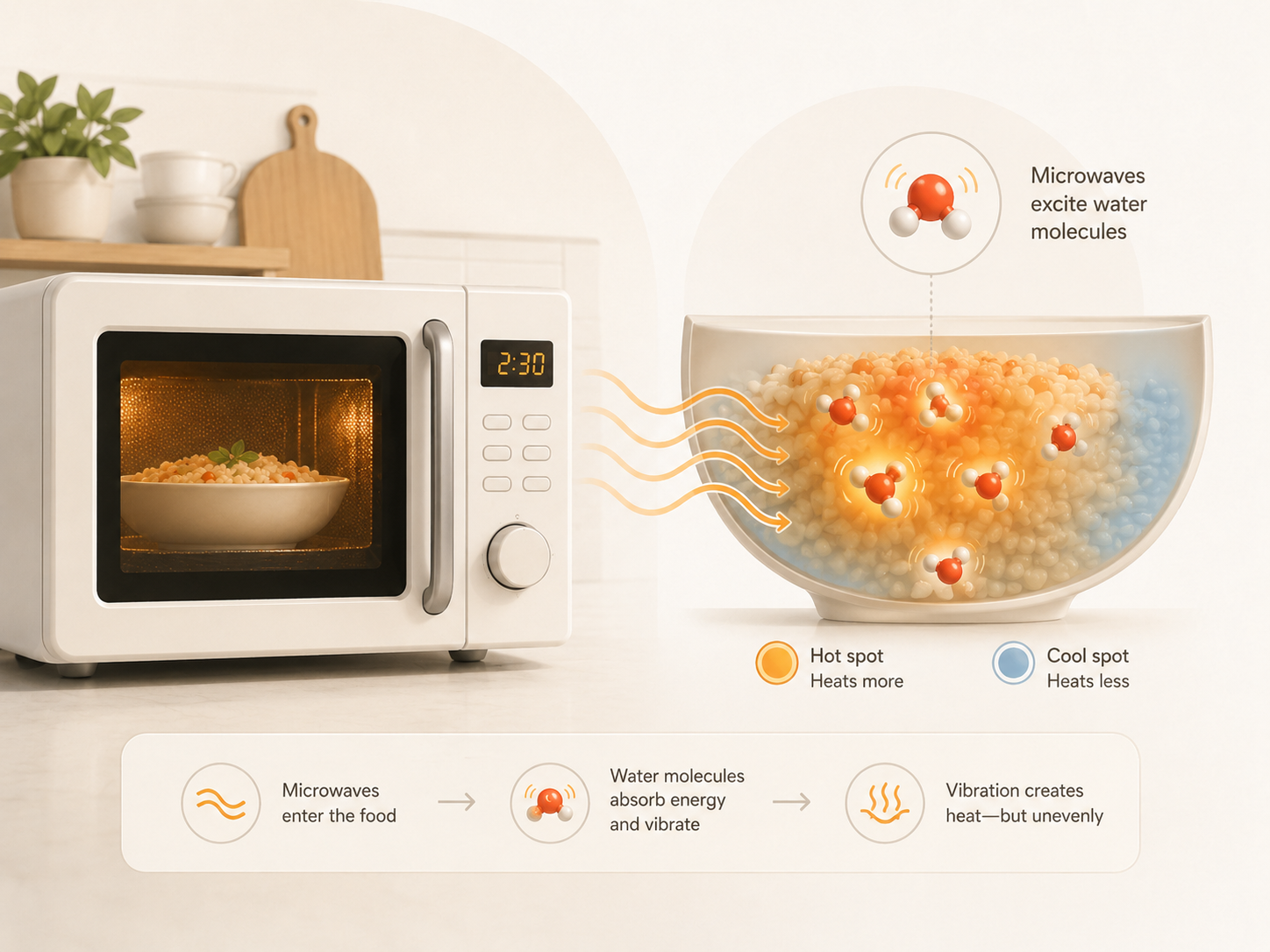
Water molecules are polar, meaning they have uneven electrical charge across the molecule. Microwave energy creates a changing electric field. As that field changes direction, water molecules and other polar molecules try to line up with it. That rapid movement creates friction-like molecular motion, and that motion becomes heat inside the food.
Foods with more moisture usually respond strongly to microwave energy. That is one reason soups, sauces, vegetables, and many leftovers can heat quickly, while dry or dense foods may heat less evenly.
Fats, sugars, salts, and density also matter
Water is important, but it is not the only factor. Fats and sugars can also absorb microwave energy differently, and dissolved salts can affect how energy moves through a food. Dense foods slow down heat movement, while airy foods may heat in pockets. A bowl of soup, a frozen burrito, and a thick casserole can behave very differently even at the same wattage.
Moisture
Moist foods often heat faster because water interacts strongly with microwave energy.
Shape
Thin, even shapes heat more predictably than thick or irregular shapes.
Resting
Standing time lets heat continue moving through the food after the oven stops.
Why uneven cooking happens
Uneven microwave cooking can happen because energy is not absorbed perfectly evenly across the food. Thicker parts, frozen centers, dense sections, or areas with less moisture may heat slower. Some parts of the food may become hot while other parts remain cooler.
Turntables, stirring, rearranging, covering, venting, and standing time all help reduce uneven heating. When package directions say to stir halfway through cooking or let food stand before eating, those steps are part of the cooking method—not optional decoration.
Why cold spots matter
Cold spots are areas that did not receive enough heat or did not receive heat for long enough. For snacks, leftovers, and frozen meals, cold spots can make food unpleasant. For foods that must reach a safe temperature, cold spots can be a food-safety concern.
That is why time conversion and safe internal temperature are separate ideas. Use this site’s internal cooking temperature chart when the food type requires a temperature check, especially for poultry, ground meat, casseroles, leftovers, and other higher-risk foods.
Why standing time is part of microwave cooking
Food can continue heating internally after the microwave stops because heat keeps moving from hotter areas into cooler areas. Standing time gives that heat a chance to distribute more evenly. Removing or shortening standing time can leave the outside hot while the center is still cooler than expected.
How this connects to wattage conversion
The calculator adjusts time based on the power difference between the instruction wattage and your microwave wattage. That helps correct the energy estimate. It does not replace stirring, rotation, container instructions, rest time, or temperature checks.
To understand the exact conversion math, read how microwave wattage conversion works. To verify food safety after cooking, use the cooking temperature chart.