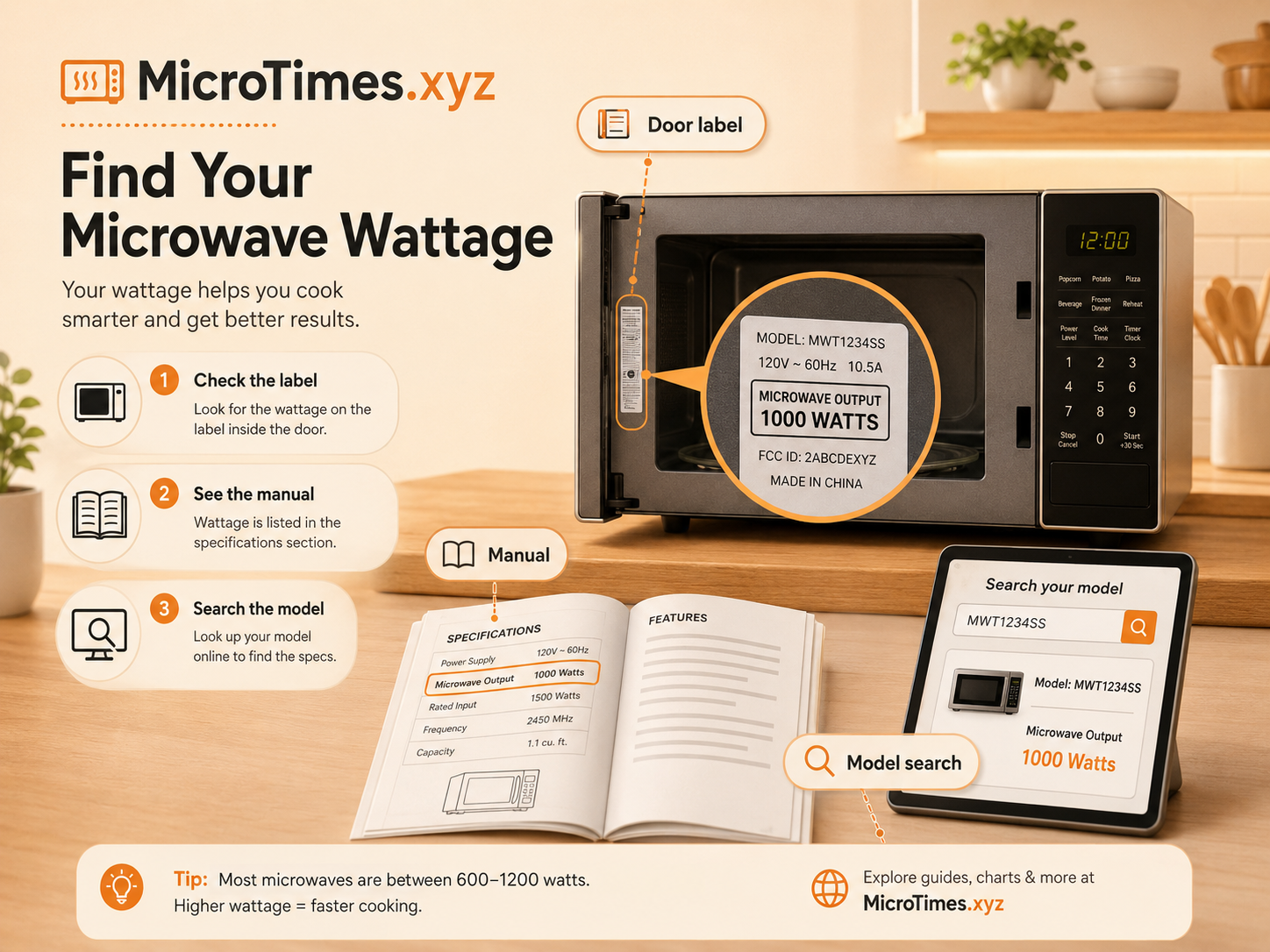
Where to look first
Start by checking inside the microwave door frame, around the back, or on the side edge of the appliance. Many units have a manufacturer label with the model number and electrical information. The cooking wattage may also appear in the owner manual or on the manufacturer product page.
Use the model number when wattage is not obvious
If the label lists only a model number, search the exact model number together with the word “wattage.” Be careful not to confuse input power with cooking output. Input power can be higher because the appliance uses electricity to run electronics, the turntable, fan, and magnetron.
Common microwave wattage ranges
| Range | Common use | Cooking behavior |
|---|---|---|
| 600W–700W | Compact or older units | Often needs noticeably more time. |
| 800W–900W | Small to mid-size units | Moderate adjustment from 1000W or 1100W instructions. |
| 1000W–1100W | Many modern countertop units | Common baseline for packaged foods. |
| 1200W+ | Larger or higher-power units | May require less time and closer monitoring. |
What if your wattage is between common numbers?
Use the exact wattage when you know it. If your microwave is 950W, enter 950W. If you only know an approximate value, choose the closest lower wattage and check the food early, then add short increments as needed.
Older microwaves may cook differently
A label rating is not a perfect measurement of real-world performance. Older microwaves can heat less evenly, turntables may not rotate smoothly, and worn or damaged door seals should be treated seriously. If a unit behaves unpredictably, replace it rather than relying on time conversions.
Best practice
Use wattage conversion to choose a better starting time, but still follow product instructions for stirring, rotating, covering, venting, and standing time.